Technology Lifecycle Management – Key Stages, Risks & Best Practices For 2025

Technology Lifecycle Management (TLM) is emerging as a critical framework for businesses seeking to stay competitive in a rapidly evolving technological environment. TLM helps organizations reduce obsolescence risks, optimize cost savings, and ensure they remain future-ready by systematically managing the lifecycle of IT assets.
According to a Gartner report, global IT spending is projected to reach $5.74 trillion in 2025. Therefore, more companies are now recognizing the strategic value of TLM in driving operational excellence and sustainable growth.
Are you one of them? Then read on!
This blog will explore the key stages of TLM, such as deployment, maintenance, and decommissioning. Moreover, it will provide you with actionable best practices to help your business maximize asset performance while minimizing disruptions.
So, without wasting time, let’s get started!
1. What is Technology Lifecycle Management (TLM)?
Technology Lifecycle Management (TLM) is a comprehensive framework for managing technology assets throughout their lifecycle, from planning and onboarding to active use and eventual decommissioning. This end-to-end process ensures that organizations extract maximum value from their technology investments, minimize downtime, and guarantee compliance with industry regulations.
Moreover, TLM often aligns with IT asset management strategies by providing a systematic approach to managing technologies. This includes processes to track, maintain, and optimize technology assets to meet evolving business objectives.
In short, when implemented effectively, a strong lifecycle management strategy simplifies decision-making and helps businesses remain agile in a world driven by technological advancements.
Why is Technology Lifecycle Management Critical?
The demand for effective TLM has intensified due to rapid changes in technology and global workplace dynamics. Trends such as hybrid work models, leveraging technology for automation, and the continued adoption of AI have also made it crucial to proactively manage the lifecycle of IT systems. Because, without a well-structured TLM, businesses face risks like increased operational inefficiencies, data vulnerabilities, and non-compliance with industry regulations.
Therefore, adopting technology lifecycle management equips organizations to gain a service-level advantage, maintain operational continuity, and reduce the risk of obsolete technology failing critical operations. According to recent stats, the global managed IT services market is estimated to grow from $223 billion in 2020 to $329.1 billion by 2025, at a CAGR of 8.1%.
This growth reflects the increasing reliance on external service providers to address IT challenges and future-proof infrastructure. So, investing in TLM is not just a strategy; it’s a critical enabler for operational growth and long-term success.
Key Stages of the Technology Lifecycle
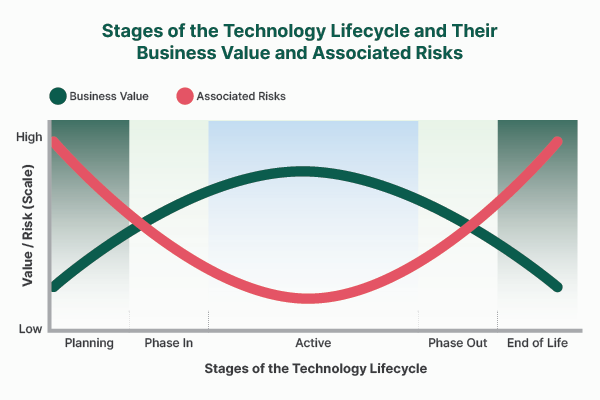
Technology lifecycle management includes five key stages that cover the entire lifecycle of IT assets. Let’s take a closer look at each stage to understand its impact on overall technology management.
Stage 1. Plan
The planning stage is crucial for laying a solid foundation for the organization’s technology lifecycle management strategy. The process starts with assessing current IT systems through gap analyses to identify areas requiring updates or replacements. Moreover, this stage ensures that technology investments are aligned with the company’s business objectives.
It creates a roadmap for mitigating risks, optimizing resources, and forecasting budgets for growth. Potential risks during this phase include misalignment between objectives and investments, overlooking future compatibility, or underestimating costs. Such oversights can result in inefficiencies down the line.
For effective planning, Teqtivity offers valuable IT asset tracking data. This enables organizations to make informed decisions about their IT asset inventory and address potential asset-related issues proactively.
Stage 2. Phase-In
During the phase-in stage, new technologies are integrated into existing systems to support evolving operational needs. Seamless integration during this stage ensures workflows remain uninterrupted. Moreover, organizations execute secure configurations during this phase, conduct effective data migration, and provide team training to ease adaptation.
However, careful attention is required to maintain compatibility within the ecosystem, as poorly managed integration can cause extended downtime or critical data loss. Teqtivity’s ITAM solution can support this stage by maintaining real-time visibility into IT assets and allowing organizations to track transitions of IT equipment. With Teqtivity, businesses can better manage their IT inventory during asset changes. It potentially reduces asset-related disruptions.
Stage 3. Active
The active stage represents the operational peak of IT systems. It requires diligent efforts to ensure that systems consistently deliver on their intended value. Regular maintenance, implementation of necessary updates, and continuous monitoring are all vital at this stage.
Therefore, organizations must run IT performance audits to meet expected service levels and identify areas for further optimization. Failing to maintain active systems can result in vulnerabilities that jeopardize data security or slow down business operations. It all leads businesses to financial and reputational losses.
Stage 4. Phase-Out
When technology reaches the end of its functional lifecycle, organizations must phase it out without disrupting ongoing business operations. These transitions involve assessing replacement solutions, pilot testing alternatives, and establishing a gradual decommissioning timeline.
That’s because it ensures operational continuity during the handoff between old and new systems. However, you might face a few potential risks, such as disruptive compatibility issues or end-user resistance to the transitions.
With Teqtivity’s IT asset management capabilities, companies can track their IT asset inventory more efficiently during the phase-out stage, providing data to help identify which assets are approaching end-of-life.
Stage 5. End of Life (EoL)
The end-of-life stage completes the lifecycle. This stage requires organizations to decommission outdated technologies while adhering to regulatory requirements. Moreover, responsibilities here include secure data destruction to maintain privacy compliance, ethical disposal to address environmental concerns, and compliance validation to avoid legal penalties. You might face some challenges here, such as improper disposal, which leads companies to eco-hazards and potential fines.
However, utilizing ITAM tools can support your organization in managing this stage more effectively. It can assist in tracking IT assets slated for decommissioning and maintaining accurate records of assets reaching end-of-life.
Teqtivity’s ITAM solution can help document the disposal process by tracking asset status changes and storing relevant asset information. This ensures that EoL practices for IT assets are well-documented and can support compliance efforts related to asset management.
Actionable Solutions for CIOs and IT Leaders
For CIOs and IT leaders, implementing effective technology lifecycle management processes requires a well-thought-out strategy. Therefore, aligning IT efforts with your key business objectives ensures that your business’s technology investments drive tangible outcomes.
Moreover, regular audits and reviews are crucial for monitoring IT assets, analyzing their performance, and tracking their lifecycle progression. This allows organizations to make informed decisions based on data, preventing inefficiencies and obsolete assets.
Utlizing Teqtivity’s ITAM solution can help organizations handle the end-of-life stage of their technology assets more effectively. It can help companies keep track of which IT equipment (like computers, servers, or other devices) is ready to be taken out of service, which eventually leads to effective retirement and optimized technology investments.
Key Takeaways
Before leaving, read the key takeaways from the article:
- Technology lifecycle management is a framework to manage technology assets from acquisition to decommissioning, ensuring optimized use and compliance.
- The key stages of TLM include planning, phase-in, active use, phase-out, and end-of-life (EoL). Each stage focuses on asset performance, updates, and smooth transitions.
- Aligning IT efforts with business objectives is vital to maximizing technology investments, minimizing risks, and driving long-term organizational growth.
- Businesses can utilize predictive tools for proactive maintenance and adopt sustainable approaches like recycling programs.
- Teqtivity’s ITAM solution can support organizations in managing their technology assets throughout their lifecycle, from acquisition to end-of-life disposal.
We hope this article has given you valuable insights into technology lifecycle management and its crucial role in driving organizational growth. Keep exploring the possibilities with Teqtivity. Request a demo today to see how we can help your business effectively manage its technology assets.