Top 10 IT Asset Management Software – A Detailed Comparison for Startups

It’s exciting to start a new business. But it also comes with countless moving parts, especially in asset management. Every device and warranty matters significantly in running operations smoothly. So, what if these assets go missing? A startup has limited resources; therefore, losing even smaller devices and accessories can lead to increased costs.
You can avoid these problems with the right tools, which can save startups their valuable resources, money, time, and even headaches down the road. Let’s look at a detailed comparison of IT asset management software for startups, highlighting the top tools, their key features, pricing, pros, and cons. So, you’ll know exactly which one fits your needs, budget, and growth plans.
How to Evaluate IT Asset Management Software for Startups
One of the most overlooked yet critical needs for startups is a reliable asset management solution. Because devices, warranties, and many other resources can quickly pile up. So, reliance on spreadsheets or manual tracking creates unnecessary risks. That’s why you need to conduct an IT asset management software comparison. The right choice enables you to track assets and empowers your organisation with visibility, compliance, and efficiency.
Remember, startups need to assess more than just the basics when comparing asset management software. They should consider some essentials, such as usability, integrations, automation, and scalability. Therefore, let’s look at some critical evaluation points to make a smart decision:
- Asset Tracking & Visibility
Real-time asset tracking is the foundation of an effective asset management system. This can improve accountability in an organization, especially if you know the exact number of assets, where they are, and who’s using them. A study by RSI Mexico found that businesses lose 35% of their assets due to poor visibility and mismanagement. However, an effective solution can reduce loss, simplify assets, and help improve control across departments.
- Lifecycle Management
A good asset management platform, such as Teqtivity, isn’t limited to deployment. It provides effective lifecycle management from acquisition to retirement. That is crucial for improving asset longevity, reducing unnecessary purchases, and enhancing visibility at every stage.
- Seamless Integrations
The modern startup tech stack includes HR, ITAD, and procurement tools. An ideal HAM solution integrates capabilities with these systems to eliminate data silos and create a unified source of truth. Therefore, every department and platform has consistent data rather than fragmentation.
- User Experience & Accessibility
A user-friendly interface, customizable reports, visual dashboards, and improved usability can drive adoption. Moreover, high-quality customer support further improves adoption. It also ensures the quick resolution of issues.
- Security & Compliance
Startups can’t afford to overlook compliance. Active compliance monitoring, audit-ready trails, and built-in access controls enable organisations to adhere to regulations and industry-specific standards. Furthermore, strong data protection also builds trust with customers, investors, and all stakeholders.
- Scalability & Growth
A startup’s needs today won’t look the same in two years. So, consider choosing a solution with flexibility and a cloud-first design. This ensures that your solution supports long-term growth and sustainability. A scalable system enables startups to adapt as their workforce and infrastructure expand without disruption.
- Reporting & Analytics
Data is only valuable if it’s actionable. Advanced reporting enables leaders to predict costs, optimize asset utilization, and pinpoint inefficiencies, providing predictive insights. It also supports data-driven decisions to eliminate guesswork.
How to Compare IT Asset Management Solutions for Startups
Startups should focus on practical differences that directly impact performance and cost-effectiveness when comparing different hardware asset management solutions. Here are some factors to consider:
- Pricing Models: Some common options might include per-device or per-module pricing. Some tools, like Teqtivity, also offer user-based pricing for predictable budgeting.
- Deployment Options: On-premise deployments are suitable for startups with data governance and specific compliance needs. Alternatively, cloud-based solutions are more flexible, quicker, and scalable.
- Customizability: The ability to customize workflows ensures the system adapts to your operations, which suits businesses of all scales and sizes.
- Automation: Prioritize an automated solution in today’s fast-moving digital environment. It helps eliminate manual tracking and reporting tasks, thereby reducing the burden on IT teams.
All of these variables can make the decisions overwhelming. So, consider making a structured comparison table, including features, pricing, integrations, scalability, drawbacks, etc. This makes it easier to see trade-offs and find out which asset management platform aligns best with your startup’s unique needs.
Top 10 IT Asset Management Software for Startups
A recent report by Exploding Topics found that more than 10% of startups fail due to outdated systems, cybersecurity issues, sub-optimal operations, and legal problems. The common link between all these common challenges is poor hardware asset management. However, the good news is that you can future-proof your startup today with an effective HAM solution.
But which one to choose? Let’s look at this detailed IT asset management software comparison for startups. It will help you choose the right tool to provide visibility, ensure compliance, improve security, and reduce costs. At the same time, teams can focus on growth.
| IT Asset Management Software | Key Features | Benefits for Startups |
| Teqtivity | Cloud-based HAM, real-time visibility, integrations (MDM, HRIS, APIs), compliance monitoring, and reporting | Centralized, scalable, easy to deploy, saves IT time, ensures compliance; best all-around solution |
| GroWrk | Device lifecycle tracking, global shipping/logistics, HR integrations | Ideal for remote-first startups, simplifies device allocation and retrieval globally |
| InvGate Asset Management | Software metering, CMDB visualization, network discovery, integrations (Teams, AnyDesk) | Balanced usability and analytics, strong compliance tools, good for growing IT teams |
| EZO AssetSonar | Asset lifecycle optimization, depreciation tracking, maintenance logs, and automation | Reduces manual work, tracks depreciation, strong for audits and IT compliance |
| Atera | AI-driven automation, remote monitoring, and integrations (Okta, Bitdefender, etc.) | Streamlines IT tasks for small teams, great for automation and remote IT management |
| SolarWinds ITAM | Asset discovery, CMDB, lifecycle monitoring, and incident/change management | Enterprise-level features, powerful compliance tools, ideal for scaling quickly |
| ManageEngine AssetExplorer | Full asset lifecycle management, purchase/contract management, reporting, and mobile app | Strong IT focus, customizable reports; great for IT-heavy startups |
| Lansweeper | Automated asset discovery, relationship-aware inventory, warranty enrichment, and network scanning | Builds a single source of truth, supports large inventories, and has strong data organization |
| Reftab | Lightweight system, barcode asset tagging, role-based access, and integrations (Jamf, Okta, Jira) | Affordable, easy to use, great for small startups needing simplicity and compliance |
| Loggle | Hardware lifecycle management, warranty/maintenance tracking, and IT cost visibility | Unified platform for cost + asset visibility, and supports a wide range of hardware |
The table above highlights the top tools, key features, and their benefits to startups. Now let’s look at them in detail:
- Teqtivity
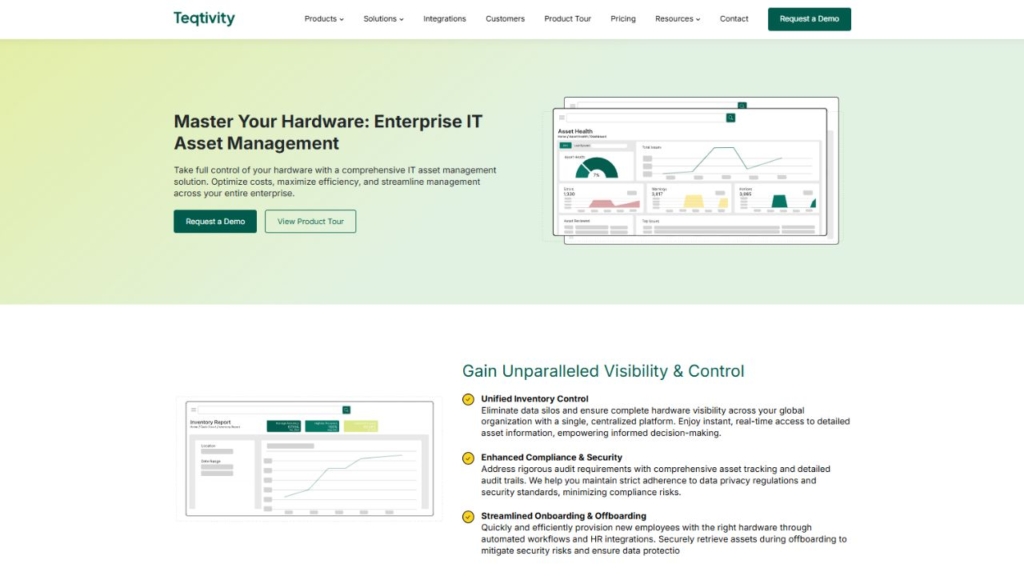
Teqtivity is an effective asset management platform that supports businesses of all sizes, including startups and established companies. It not only helps organizations sustain their operations, but it also provides options to scale. This HAM system goes way beyond basic asset tracking. It allows teams to gain real-time visibility and manage all their devices and warranties across their entire lifecycle.
One of the top reasons to choose Teqtivity is that it is a centralized, cloud-based solution. It enables businesses to monitor their assets across multiple locations, departments, and remote offices. Moreover, Teqtivity supports dozens of integrations and has a user-friendly interface, making it ideal for startup teams with limited IT resources. Combine that with its user-based pricing and cloud deployment, and you can integrate Teqtivity today in your infrastructure without any overhauls and disruptions.
Pricing Model
- Flexible, user-based pricing model with a 14-day free trial.
Pros
- Offers built-in reporting for smarter decision-making.
- Supports integrations with MDM, ITAD, HRIS, Vendor Management, service desk, APIs, and many other business tools.
- Has compliance monitoring and audit-ready documentation.
- Suits many industries, including finance, tech, education, and healthcare.
- Scalable for startups.
Cons
- Might be feature-rich for very small startups.
- GroWrk
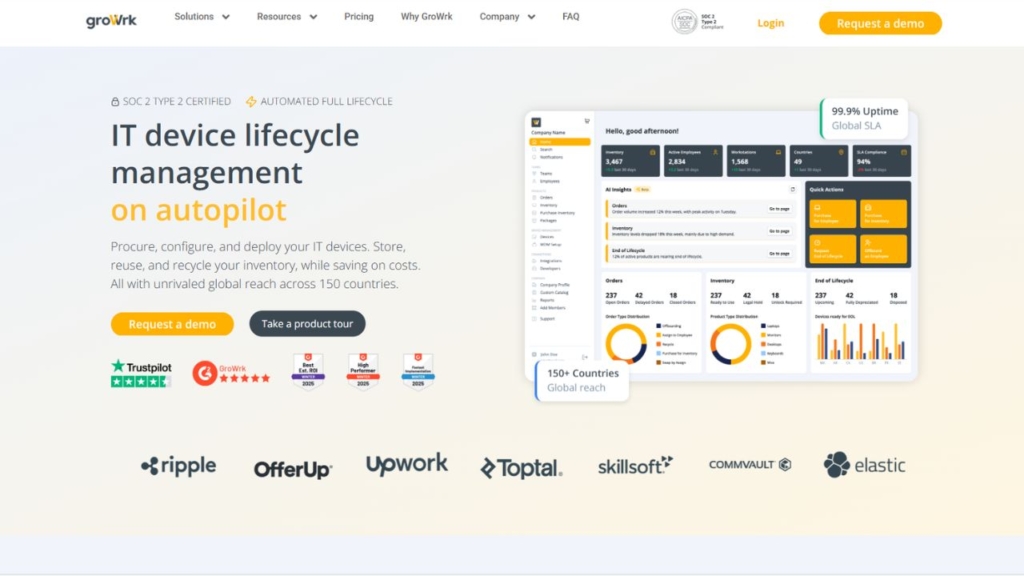
GroWrk is another popular asset management tool, built specially for distributed teams. It helps startups track and ship IT devices globally. GroWrk has a stronger focus on hardware allocation and retrieval, making it a good choice for remote work.
Furthermore, GroWrk offers end-to-end device lifecycle management to track a device across different stages. You can also easily integrate this HAM solution with HR systems. Overall, it is a solid choice for remote-first teams because of its remote logistics support.
Pricing Model
- Subscription-based pricing plans with a free version that supports a pay-as-you-go model.
Pros
- Effective for global teams.
- Strong logistical support.
- Simplifies device provisioning.
Cons
- Lacks advanced reporting.
- InvGate Asset Management
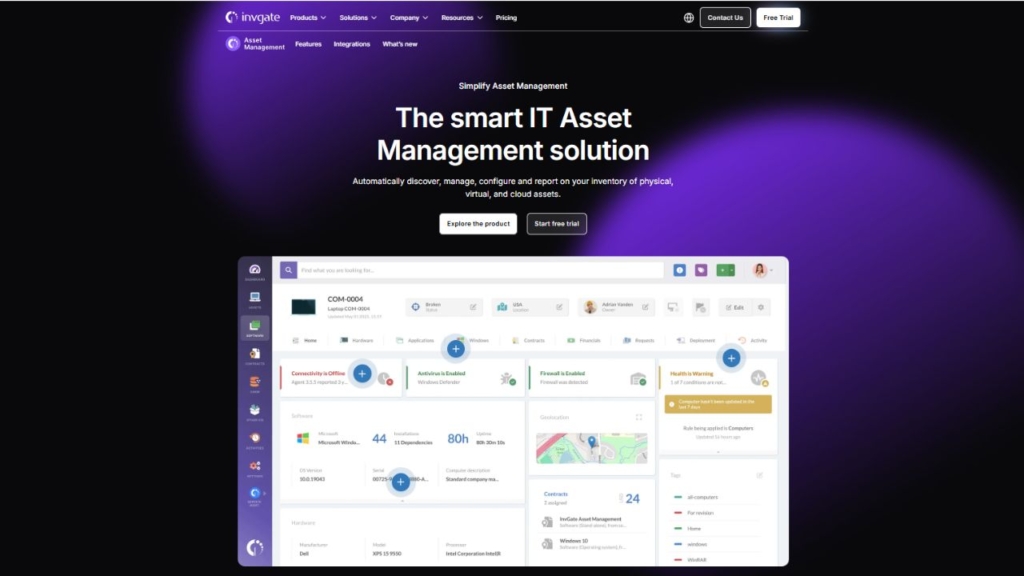
InvGate provides some essential and useful ITAM tools for startups. However, it is best known for its balance of usability and analytics. This helps businesses that want simpler deployment. It also provides advanced features, such as software metering, network discovery, IT security, and CMDB discovery and visualization.
InvGate supports integrations with several business essentials, like AnyDesk and Microsoft Teams. This also empowers remote teams to work with unified data and prevent silos. In addition, InvGate allows on-site deployment in its custom pricing plan.
Pricing Model
- Per-asset subscription-based plans for monthly or annual billing.
Pros
- Intuitive user interface.
- Built-in compliance features.
- Supports tens and thousands of assets.
Cons
- Quite complex for startups and small businesses.
- Asset-based pricing is not ideal for scalability.
- EZO AssetSonar
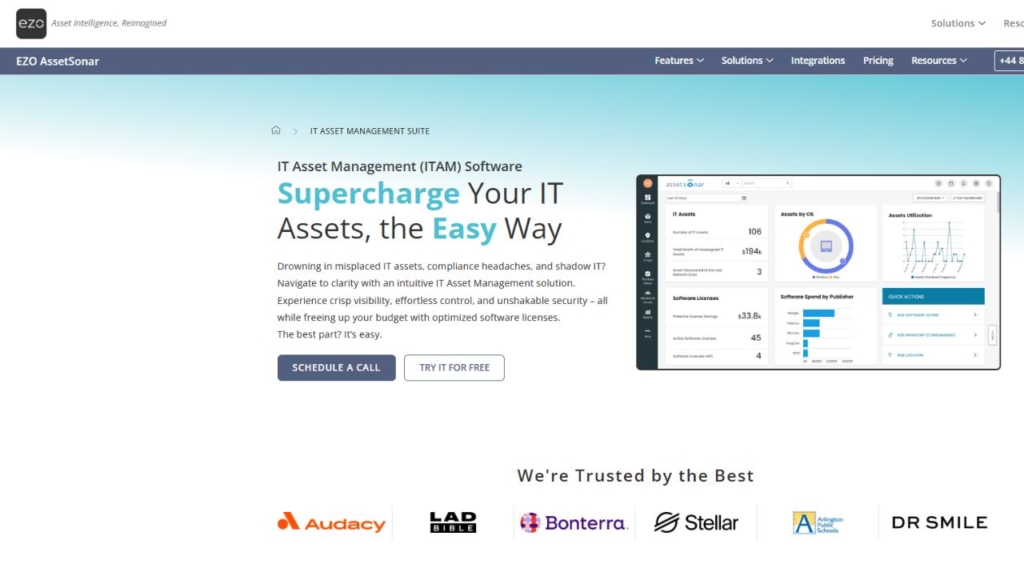
AssetSonar is one of the most popular choices, known for its active asset monitoring and tracking. It offers options to optimize the lifecycle of IT assets in an enterprise, while automating routine workflows. The primary aim of EZO AssetSonar is to free up organizations from repetitive IT management processes.
AssetSonar offers some unique functions, such as depreciation calculation. This enables teams to track depreciation rate and automate their end-of-life forecasting. It also tracks maintenance and service history of assets to create detailed logs for audits.
Pricing
- Different subscriptions for HAM, SAM, and complete ITAM.
Pros
- Smooth employee check-in/check-out processes.
- Automated compliance and audits.
- Offers user management.
Cons
- Steeper learning curve, especially for inexperienced teams.
- Expensive for smaller startups.
- Atera

Atera is one of the go-to ITAM choices for startups that need heavy automation. The tool offers many AI-driven key features, such as AI agents, IT Copilot, and workflow automation. But it is also quite useful for remote teams. Atera supports distributed teams with its remote access controls and global monitoring.
Atera eases smaller teams with software, patch, networking, and alert management features. It provides integrations with various tools, including both popular and lesser-known ones. Some examples include Okta, WhatsApp, Acronis, Homebrew, Bitdefender, etc.
Pricing
- Fixed subscription-based pricing plans.
Pros
- In-depth automation and AI-driven features.
- Has a designated customer service portal.
- Provides IT documentation for compliance.
Cons
- Fixed pricing plans are not suitable for smaller teams.
- Lacks some detailed features like asset lifecycle management and maintenance alerts.
- SolarWinds ITAM
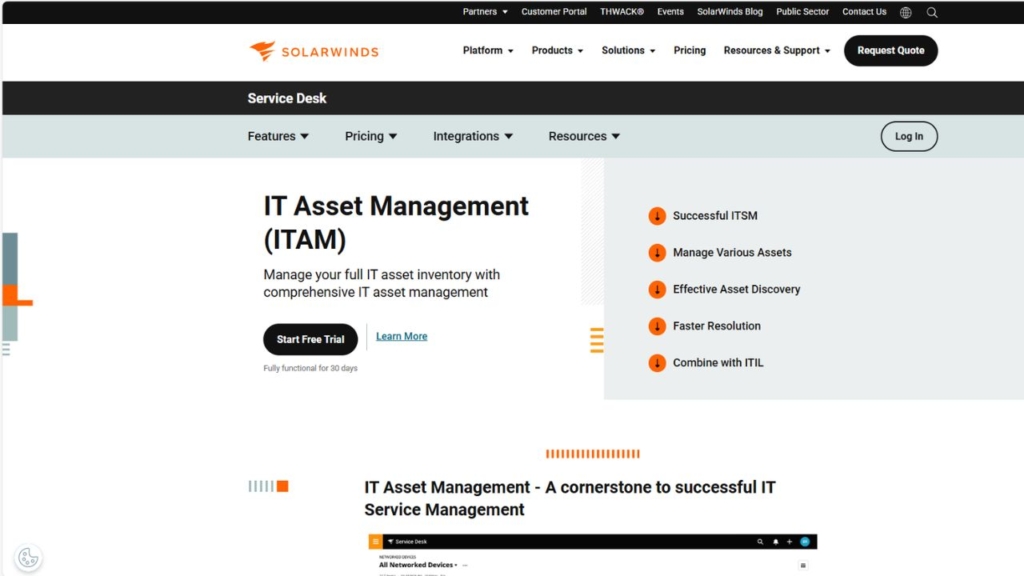
SolarWinds offers a complete ITAM suite with enterprise-level features, which is suitable for startups aiming for rapid scale. It provides asset discovery and reporting, allowing teams to scan the network and track all connected devices. The tool can track all IT assets, including physical, virtual, software, and peripherals.
SolarWinds ITAM also supports incident and change management for proactive risk mitigation and asset management implementation. It has built-in CMDB software to monitor the entire IT infrastructure and relationships between your devices. Plus, you can track all this information on a single dashboard.
Pricing
- Custom, modular pricing based on features and deployment.
Pros
- A feature-rich suite for asset management.
- Supports scaling businesses.
- Strong compliance support.
Cons
- Could be complex for new businesses.
- Lacks some essential integrations.
- ManageEngine AssetExplorer
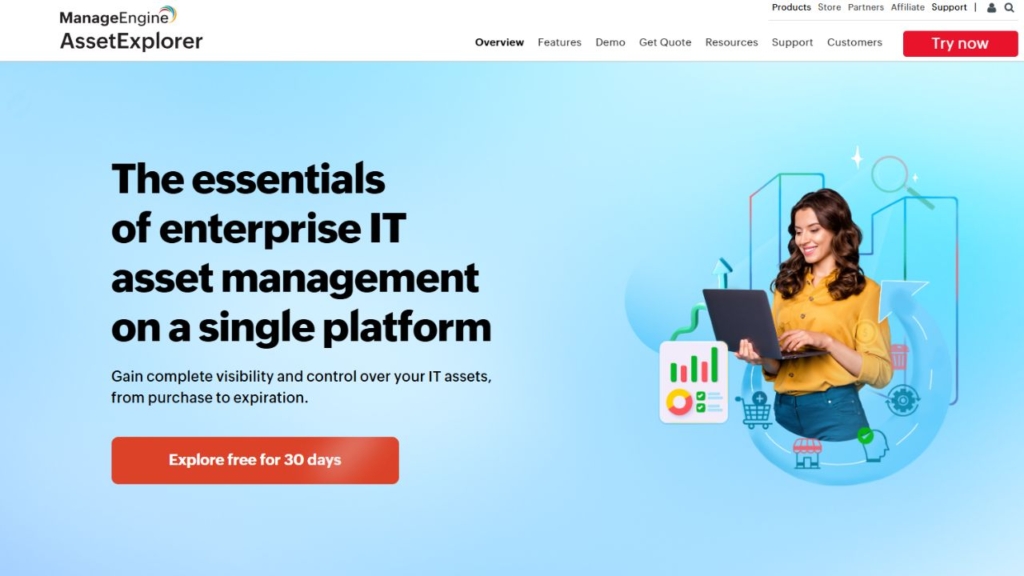
ManageEngine is an IT-focused asset management platform with deep functionality. It is suitable for IT-heavy startups that require detailed tools for hardware and software license management. This tool monitors the complete lifecycle of assets, from procurement to disposal. In addition, ManageEngine helps businesses manage purchase orders and contracts, incorporating these functions into business workflows.
AssetExplorer by ManageEngine generates detailed, custom reports for audits and data-driven decisions. It also comes with a mobile application for iOS and Android that offers all the essential features to track and manage assets from anywhere.
Pricing
- Customized pricing quote.
Pros
- Quick, cloud-based deployment.
- Detailed customization for reporting and workflows.
- Monitors both hardware and software assets.
Cons
- Steeper learning curve.
- Limited remote control tools work.
- Lansweeper
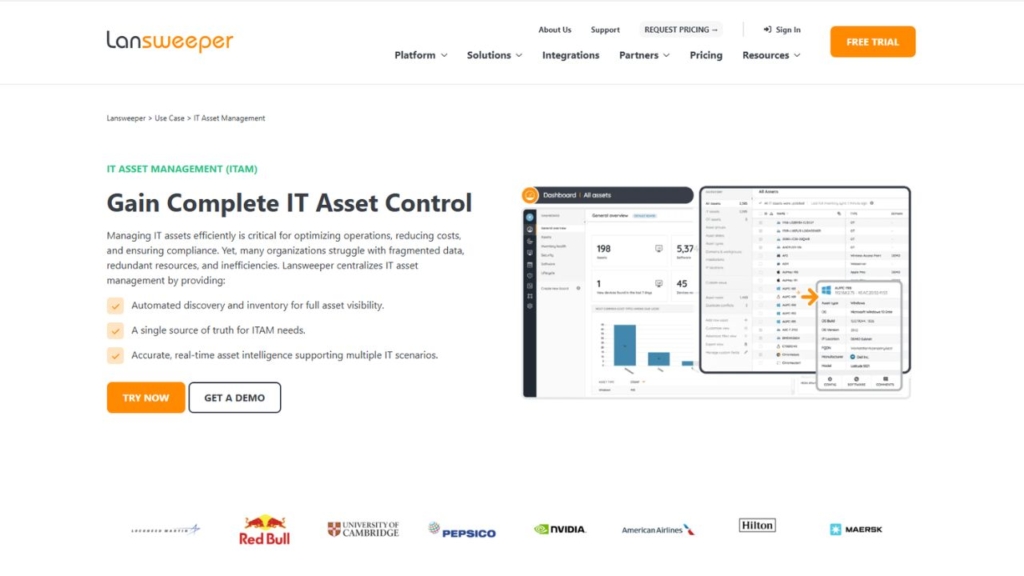
Lansweeper provides automated discovery tools and automated asset lifecycle management. It also provides smart inventory management functions with seamless integrations to eliminate data silos and build a single source of truth. The tool also supports detailed features, such as group assets, relationship-aware inventory, and built-in enrichment for custom fields and warranty details.
Moreover, Lansweeper offers network scanning and data organization. It enables you to merge data from multiple sources. The HAM lets users add custom fields, classify devices, and automate mundane inventory tasks. You can also integrate its ITAM system with ITSM for broader asset oversight.
Pricing
- Fixed, subscription-based pricing and custom plans.
Pros
- Robust asset discovery tools.
- A strong focus on data and inventory management.
- Supports more than 10,000 assets.
Cons
- Not suitable for remote teams.
- Limited support for Mac and iOS devices.
- Reftab
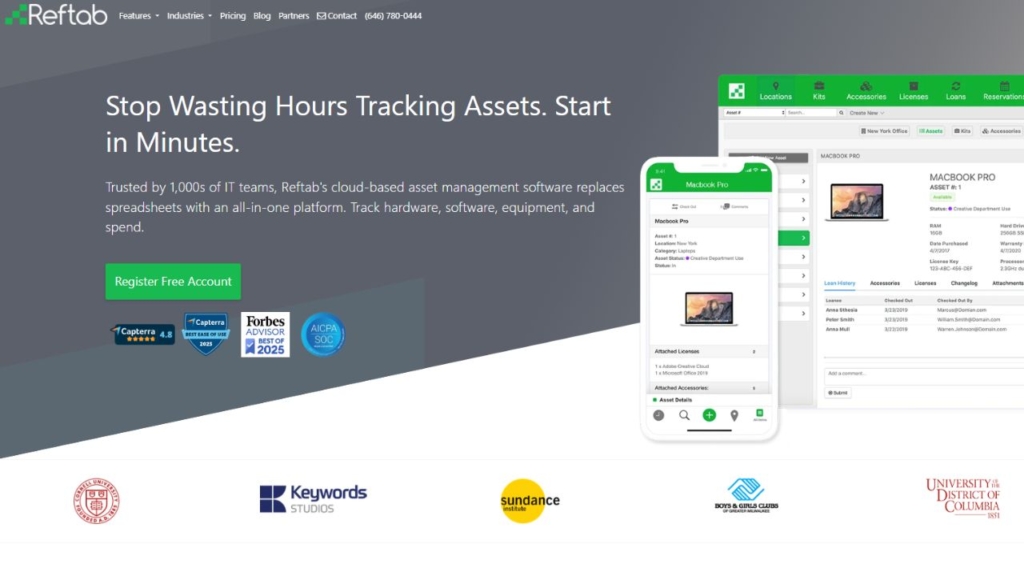
Reftab is a comparatively lesser-known, lightweight IT asset management system geared towards smaller startups. It focuses on simplicity, ease of use, and affordability. However, it still offers the key features new businesses need to manage their devices. It also supports integrations, such as Jamf, Jira, Okta, Intune, and Microsoft Entra, to build a unified and scalable IT stack.
Reftab doesn’t compromise compliance and security. It comes with role-based access rights and detailed reports to maintain cybersecurity and ensure audit-readiness, respectively. In addition, it uses smart asset tags and barcodes to label devices for easier, more effective tracking.
Pricing
- Fixed pricing plans for annual billing.
Pros
- Easy to understand and use.
- Offers smart inventory controls.
- Has maintenance and work order management.
Cons
- Lacks advanced analytics.
- Does not offer automated alerts and notifications.
- Loggle
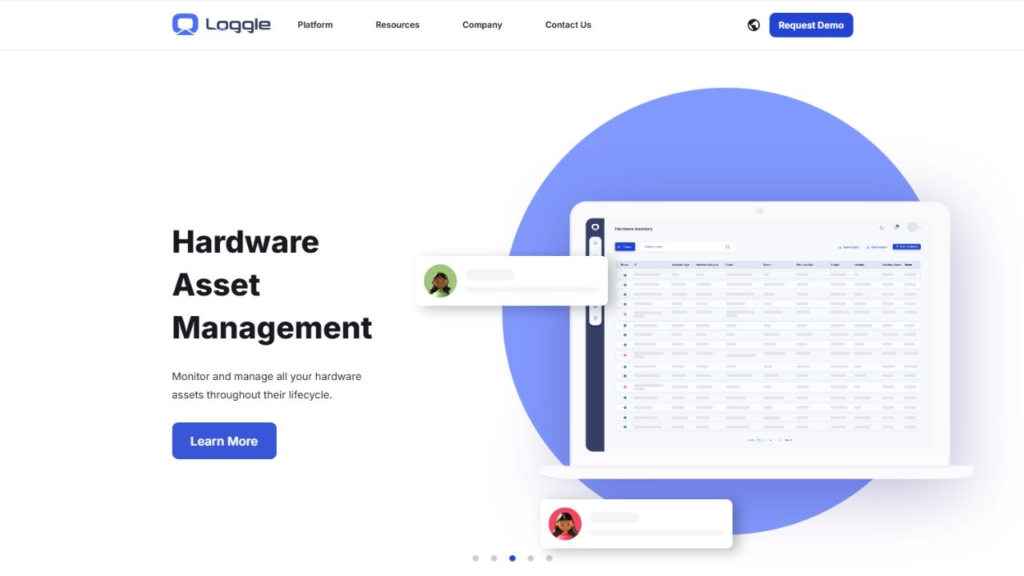
Loggle comes with different solutions, including IT cost management, application portfolio management, and hardware asset management. It offers a unified platform to track hardware assets through their entire lifecycle. This HAM system combines maintenance and warranty monitoring in real-time. Loggle is effective for startups that want a full picture of both the physical device portfolio and its associated costs without data fragmentation across multiple tools.
In addition, the tool provides maintenance notifications. Therefore, teams can proactively service their assets to keep them operational. The best part is that it’s not limited to specific assets. Loggle can track and manage servers, switches, routers, virtual machines, printers, firewalls, access points, notebooks, tablets, mobile phones, and hand terminals.
Pricing
- Custom, quote-based pricing model.
Pros
- Useful for HAM; visibility over cost, warranty, and maintenance.
- Suits startups that want connected solutions.
- Comparatively easier to use than many HAM systems.
Cons
- Lacks some essential features like guided onboarding and offboarding.
- Some advanced analytics are missing.
Why Teqtivity Stands Out for Startups
Overwhelmed by the IT asset management software comparison? Teqtivity is the safest bet. It offers innovation, visibility, flexibility, and a user-first design philosophy, making it ideal for startups across various industries.
Let’s see why it is ideal for startups:
- Lifecycle Visibility & Innovation
Teqtivity covers more than just device tracking. Its solution is built around full lifecycle visibility, from procurement and deployment through usage, maintenance, and retirement. This gives startups a clear picture of hardware, warranties, and cost data. So, they can make better decisions proactively about maintenance, repairs, and replacements. Also, lifecycle management ensures detailed documentation for all stages to ensure audit-readiness.
- User-Based Pricing & Predictability
One of the biggest headaches with many ITAM tools is hidden cost escalation as your asset portfolio grows. Teqtivity helps startups avoid that trap with transparent, user-based pricing, enabling teams to manage budgets without surprise changes.
Teqtivity’s pricing strategy aligns directly with how startups grow; they often add users before asset acquisition. Therefore, costs scale in line with adoption, rather than forcing radical shifts in vendor choice as the hardware catalogue expands.
- Rapid Onboarding & Customizable Workflows
Time is valuable for startups, especially in their early stages. Teqtivity offers quick and smooth onboarding with a setup designed to integrate into existing business workflows rather than forcing teams to adapt. Moreover, its user-friendly interface, combined with customizable workflows, ensures that teams can adopt the system with minimal friction.
- Real-Time Tracking & Control
One of the most impressive features that successful businesses prioritize is its real-time asset tracking. This ensures that teams always know if their assets are assigned, in repair, in transit, decommissioned, or gathering dust. The results include a lower risk of loss, theft, or misallocation. Teqtivity combines these features with audit trails and access controls. Therefore, leaders can rest well knowing that only authorized users can access or upgrade asset data, guaranteeing compliance.
- Strength in Integrations
Teqtivity excels in integrations. You can connect it to all your existing business tools, allowing you to build a unified asset infrastructure. Some popular integrations include Okta, Jamf, Jira, Intune, Cisco Meraki, Freshworks, Firstbase, Slack, and Google Workspace.
Ready to take control of your IT and hardware assets without the chaos? Teqtivity is more than just an asset management system for startups. It provides real-time visibility, seamless integrations, and user-based pricing designed to grow with businesses. Even better, it supports scaling teams, tightens compliance, and streamlines workflows to deliver the clarity and efficiency you need to stay ahead. Request your free demo today and empower your startup with Teqtivity.
People Also Ask
What are the most important features for startups in IT asset management software?
Some of the most important IT asset management features for startups include real-time asset tracking, lifecycle management, and robust access controls. A user-friendly interface is also highly recommended. It makes it easier to create customizable reports and streamline workflows. These capabilities enable teams to scale confidently and automate manual tasks. Moreover, they support data-driven decisions about their IT and hardware assets.
Why should startups invest in IT asset management software early on?
Startups should invest in IT asset management software early on to ensure that every device, warranty, and subscription is properly tracked and managed. It reduces financial waste while enabling scalable growth. Also, real-time asset tracking and visibility into the number of assets enable young businesses to avoid common issues that incur costs, such as duplicate purchases.
What integrations matter most for startups in IT asset management software?
Some essential integrations for startups in IT asset management software include HRIS for onboarding/offboarding assets, procurement tools for cost tracking, and service desk platforms to manage support requests. These integrations streamline workflows and ensure that asset data flows across systems without manual updates. Furthermore, they eliminate data silos and provide unified data throughout all departments.
How should a startup choose the right IT asset management software?
To choose the right IT asset management software, startups must assess both current needs and future growth. Factors like scalability, ease of use, key features, and customer support should guide decision-making. In addition, startups should also choose between a cloud-based or on-premise deployment, according to their security and infrastructure requirements. A well-thought-out IT asset management software comparison helps identify tools that suit business goals, budget, and operational structure for the best long-term fit.
What pricing models work best for startups?
For startups, user based pricing is often a cost-effective approach. This helps with the rapid expansion of the asset portfolio and IT infrastructure in a new business without costing extra for every device. Many tools, such as Teqtivity, offer user-based pricing, so you can grow your asset catalogue without pricing issues.
How difficult is ITAM onboarding and implementation for startups?
Generally, it isn’t that difficult. That is because tools like Teqtivity offer guided onboarding and customer support. This makes implementation smoother and reduces the need for manual setup. Even distributed or remote-first startups benefit from cloud-based platforms that instantly centralize data. In short, new businesses can enhance their ROI without slowing growth momentum by prioritizing software with flexible deployment and rapid onboarding capabilities.
Key Takeaways
Before leaving, read the key takeaways from the article:
- Startups risk failure without proper asset management. Effective software ensures compliance, security, cost control, and streamlined growth-focused IT operations.
- A detailed IT asset management software comparison for startups highlights top platforms, their key features, pricing models, and suitability for startups scaling efficiently.
- Teqtivity stands out as the most balanced solution. It offers real-time visibility, lifecycle tracking, and seamless integrations tailored for growing startup needs.
- Modern asset management solutions empower startups to manage hardware devices, automate workflows, and maintain compliance with regulatory and security standards.
- Effective onboarding, workflow automation, and integrations with HRIS, ITSM, and procurement systems strengthen workflows and future-proof startups against operational inefficiencies.
- Comparative analysis of asset management platforms enables startups to identify scalable and cost-effective systems. These solutions simplify compliance, optimize asset allocation, and enhance long-term operational efficiency.