What Are The Unique IT Asset Challenges Faced By Schools?

Technology shapes almost every aspect of classrooms, connecting students and teachers in ways that seemed far off a decade ago. Still, as tech tools like laptops, tablets, and projectors become common in schools, managing these assets turns into a job full of hurdles. It goes beyond just keeping a list; instead, it involves careful planning, accurate tracking, and clear procedures to meet high expectations.
Because, without a strong asset management system, it’s easy for devices to get lost, misused, or outdated. Therefore, for many educational institutions, keeping track of devices isn’t just another task—it’s a challenge that needs new solutions.
Let’s take a closer look at the unique IT asset challenges faced by schools and consider how using practical systems can help schools effectively manage the tools they depend on. Let’s get started!
7 Top IT Asset Challenges Faced By Schools
Managing IT assets in schools presents unique challenges, each requiring thoughtful solutions to ensure technology effectively supports educational goals. Below are the top challenges schools commonly face:
| IT Asset Challenges | Brief Explanation |
|---|---|
| Decentralized and Manual Asset Tracking | Multiple systems and outdated methods, like spreadsheets for asset tracking. |
| Lifecycle Management Difficulties | The inability to track the status of each device from its procurement to its disposal. |
| Security and Data Privacy Risks | Schools are targeted for cyberattacks due to sensitive data; risks include ransomware and data theft. |
| Budget Constraints and Cost Optimization | Limited funding restricts investment in new technology and maintenance. |
| Integration and Workflow Inflexibility | Inconsistent data due to multiple management systems causing data silos. |
| Support and Training Gaps | Lack of awareness in the administration and staff about asset management. |
| Ensuring Digital Equity | To ensure every single student gets the right learning solutions that are needed. |
The above table highlights the most common IT asset challenges in schools. Let’s explore these challenges in detail to gain a better understanding.
1. Decentralized and Manual Asset Tracking
Decentralized tracking is one of the biggest challenges that can affect the overall school’s data integrity. It prevents schools from tracking assets from a single source of truth. Instead, the data is scattered throughout multiple systems.
What makes it worse is the manual asset tracking approach. It is time-consuming, requires significantly more effort, and causes more mistakes. And yet, 42% of small organizations still use manual tracking and outdated methods like spreadsheets.
Yes, an automated ITAM solution might seem a little expensive at first. But, in the longer run, it isn’t. It prevents costly mistakes and inventory inaccuracies that quickly add up, making budgeting even more challenging. Additionally, outdated approaches like spreadsheets are inefficient, particularly for managing large inventories.
For example, Teqtivty provides centralized and automated asset tracking. It takes the burden off the IT staff’s shoulders and offers a single source of truth. Therefore, even administrators without technical experience can easily monitor each asset across multiple campuses, thereby increasing overall organizational efficiency.
2. Lifecycle Management Difficulties
Schools find it challenging to monitor the health of each asset, which is another limitation of manual or decentralized tracking. Therefore, institutions can’t take proactive steps to ensure optimal equipment health.
This leads to device malfunctions and the use of outdated technologies in classrooms. Additionally, sudden breakdowns and unexpected repairs become even more expensive. They also disrupt the learning process, which makes business operations inefficient.
However, to solve this problem, schools can use Teqtivity ‘s lifecycle management. By opting for it, you can take proactive measures to track an asset’s health to schedule repairs, maintenance, and replacements.
3. Security and Data Privacy Risks
Security risks are a major concern in the education sector. You might be surprised to learn that many schools face cyberattacks every year. It leads to institutions losing sensitive data of staff and students.
In fact, according to recent surveys by the Department for Science, Innovation and Technology (DSIT), 71% of secondary schools reported experiencing a breach or cyberattack in the past year. See the percentage of organizations that have identified breaches or attacks in the last 12 months.
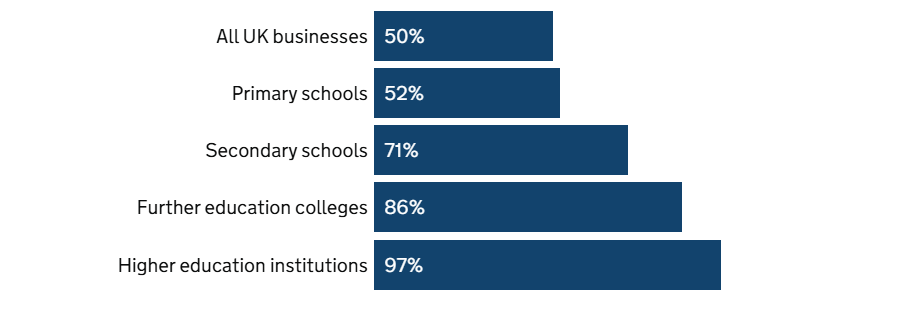
We also know that a single attack can disrupt classes and compromise sensitive information. Cyberattacks can also disrupt learning processes by affecting the school management systems. Thus, the school IT staff needs to spend hours to get the systems back online and regain control.
Teqtivity also addresses this issue by integrating with existing tools and maintaining a record of each device, location, and assigned users.
4. Budget Constraints and Cost Optimization
Budget constraints are challenging because schools typically have limited IT budgets, which forces institutions to make the most out of every dollar. But what actually happens is that administrators end up using outdated technologies. They might also be unable to reschedule maintenance, repairs, or replacements due to limited budgets.
Ultimately, these budget constraints can cause schools to fall behind, especially in the learning models. Moreover, poor cost optimization further contributes to this problem. It may also lead schools to make poor decisions about their resource allocation.
Therefore, schools may end up purchasing duplicate devices or failing to acquire essential equipment. All of these factors drain the already stretched resources. However, Teqtivity can overcome this problem. It provides real-time data, which helps make data-driven decisions. In addition, it can highlight which devices are idle or being overused, allowing you to redistribute resources more efficiently. This maintains a cost efficiency and balanced budget overall.
5. Integration and Workflow Inflexibility
The inability to integrate ITAM with your existing system is a real hassle. Because if you use multiple systems that do not collaborate, you will end up with scattered data throughout several platforms, which can affect data integrity and accuracy. Also, it will take more time to navigate all these platforms to find the required data. It ultimately affects workflow inefficiency in schools.
However, an ITAM solution like Teqtivity easily integrates with existing school systems, helping to eliminate data silos and allowing different departments to collaborate more effectively. By doing so, it streamlines the school’s overall workflow by minimizing obstacles.
6. Support and Training Gaps
Appropriate training and support is highly important for using the ITAM effectively because not every staff member is equipped to deal with IT assets. That is why devices often go missing, as administrators struggle to track them. Hence, it becomes a necessity to train teachers and staff to handle the ever-changing IT requirements.
If you’re also facing this problem, consider choosing a solution like Teqtivity, which provides staff training and support. It also offers a simple and user-friendly interface, which already makes navigating the system easy. However, if you still encounter problems, you can receive ongoing support to gain a deeper understanding.
7. Ensuring Digital Equity
Digital equity for every student, regardless of background, is a goal for every school. When devices aren’t tracked closely, some students may go without or face longer waits for repairs. Additionally, such issues create disparities among students, negatively impacting the institution’s reputation.
However, Teqtivity is specifically designed to address these challenges in schools. It enables real-time monitoring of device distribution, allowing administrators to identify gaps and ensure equitable access to devices. This platform generates custom reports that help answer community questions and demonstrate progress toward equity goals.
Moreover, it sends automatic assignments and notifications, which ensure that students who need devices or replacements are promptly served. All this reduces the risk of anyone being left behind.
In conclusion, although schools face several unique IT asset management challenges, these challenges can be overcome using a centralized and cloud-based solution like Teqtivity, which provides automated alerts, lifecycle management, data security measures, and ongoing training. Interested to know more? Book a demo now and discover how Teqtivity can address your inventory management challenges.
Key Takeaways
Before leaving, read the key takeaways of the article:
- Outdated IT asset management methods, such as spreadsheets, can be disastrous for schools. In large inventories, they can get overwhelming, take more time, and are more prone to errors.
- Consider using a centralized tracking system like Teqtivity. Therefore, you can track all assets from a single source in real-time.
- IT budget constraints can highly impact the educational quality in schools. However, you can utilize an advanced ITAM solution to make more informed budgeting decisions and maximize the value of your limited resources.
- It is highly important to use a lifecycle management tool. This way, you can proactively set alerts for maintenance before the problem escalates.