What Is Enterprise Asset Management Software? Everything You Should Know

Have you ever thought about how large organizations track thousands of assets, from laptops and mobile phones to servers and networking equipment? Well, they use enterprise asset management (EAM) software. It’s the powerhouse solution that helps enterprises monitor, maintain, and optimize their assets throughout their lifecycles.
But that’s not all an EAM does. So, what is enterprise asset management software? More importantly, why does it matter more than ever? Let’s find out these answers in this blog.
What is Enterprise Asset Management Software?
Enterprise asset management software is a tool that helps organizations track, manage, and maintain their physical assets and warranties. This way, you can get a clearer picture of where your assets are, how they are performing, and when they need maintenance or replacement.
The result? Enterprises experience extended asset lifespans, reduced downtime, increased operational efficiency, and improved cost savings. Moreover, an EAM solution is not limited to just a handful or thousands of assets. Most systems, such as Teqtivity, offer a scalable approach, meaning they can easily grow with the increasing number of assets in your organization.
Core Functionalities of Enterprise Asset Management Software
Enterprise asset management software has significantly improved over legacy systems and outdated spreadsheets. Furthermore, it also prevents manual logs—which cause human error and consume time.
Today, an effective and modern EAM solution offers these core features:
- Full Asset Lifecycle Management
Asset lifecycle management is one of the most important features of an EAM solution. It helps you track the full journey of an asset, starting from its acquisition and deployment to maintenance and secure disposal. Therefore, EAM platforms allow you to track each stage with accuracy, ensuring compliance and optimization at every step.
- Inventory & Procurement Tracking
Effective inventory management is essential. Because enterprises today have large inventories, which are nearly impossible to track with manual and traditional inventory checks. Thus, an EAM platform provides detailed asset data and real-time inventory oversight.
This ensures that IT teams know exactly which assets are deployed, in storage, or nearing the end of their life. Moreover, integrated procurement tools with EAM help streamline new asset acquisitions, track vendor agreements, and monitor order fulfillments.
- Help Desk & Ticketing System Integrations
Teqtivity offers seamless integrations with top help desk and ticketing platforms, such as Jira and Zendesk. This allows you to view, update, and manage asset details directly within Jira or Zendesk tickets—consolidating essential asset and service request information in one place. So, your IT team can link asset data instantly to support tickets. This ensures quicker resolutions and reduces the need for manual effort switching between systems. As a result, operations become more efficient, and users experience reduced downtime while staff gain real-time visibility into asset status and activity.
- Reporting and Analytics
Actionable insights are critical for continuous improvement. Therefore, enterprise asset management software offers advanced reporting and analytics, allowing platforms to monitor all the essentials with visual dashboards. These dashboards cover performance, costs, and risk levels, empowering teams to optimize processes and plan upgrades more efficiently.
- Powerful Integrations & Complexity
Today, enterprises demand systems that connect seamlessly with their existing platforms. If not, they might face data siloes and fragmentation. Luckily, modern EAM systems easily integrate with MDM, ITSM, vendors, People Management, and APIs. These integrations ensure all departments keep their data unified and updated across the entire infrastructure.
The Role of EAM Software in IT & Hardware Asset Management
Enterprise asset management software plays a key role in keeping hardware and IT assets under control. This ensures fewer budget drains, better maintenance planning, and smarter decisioning. Simply put, it takes the guesswork out of IT and hardware asset management. So, your teams can focus more on strategy and less on updating spreadsheets.
How Does Enterprise Asset Management Software Empower IT Leaders?
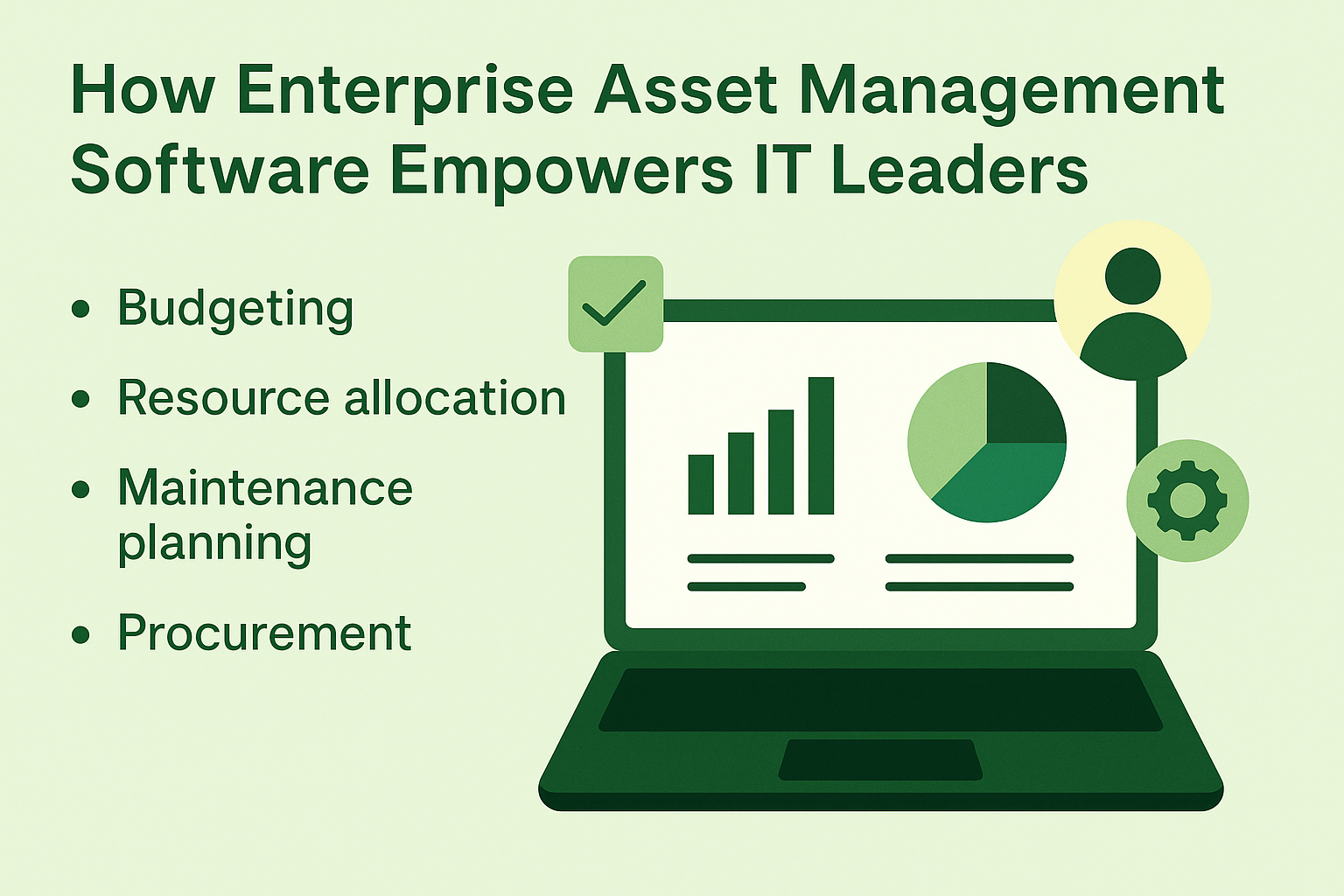
Modern EAM systems provide a holistic approach to managing the entire lifecycle of IT and hardware assets. IT teams can track every step and movement of their assets in real-time. This empowers IT leaders and even other non-technical stakeholders to make data-driven decisions. So, they can optimize their:
- Budgeting
- Resource allocation
- Maintenance planning
- Procurement
An EAM solution like Teqtivity provides customized reporting. It enables businesses to tailor these reports according to their specific needs. These reports also enable teams to make smarter scalability plans.
EAM software is no longer just a secondary tool for tech-focused enterprises; it’s a necessity. It brings together inventory management, asset maintenance and connects with existing systems to provide reliable, compliant, and real-time data, all in a single screen.
Key Benefits of Enterprise Asset Management Software
Now, you know what an enterprise asset management solution is. But do you know the benefits it offers? Here are the key benefits of EAM software:
- Modern EAM systems deliver real-time insights into all physical assets, enabling organizations to track their locations, condition, and usage across the enterprise. This centralized asset data significantly improves visibility and control.
- Automated work order management and integrated maintenance schedules help organizations save time, reduce operational costs, and avoid unplanned breakdowns.
- Enterprise asset management tools provide the essential compliance and audit tools. Also, they automate compliance checks, maintain accurate records, and issue real-time alerts, empowering teams to spot issues before they become bigger problems.
- An advanced EAM provides detailed reporting and analytics. Therefore, leaders and stakeholders gain instant access to asset utilization, financial impacts, and lifecycle forecasts to support smarter planning.
- A modern asset management (EAM) software connects easily with ITSM, ERP, HR, and MDM systems, improving workflow automation and ensuring a single source of truth for every asset.
These benefits make enterprise asset management easy, even for those using hundreds or thousands of assets and warranties. In addition, EAM solutions enable enterprises to be future-proof and scalable.
Use Cases of Enterprise Asset Management Software
Enterprise asset management software is not limited to just IT teams. These solutions can help all stakeholders and department heads in an enterprise. Here are the use cases of EAM software:
- IT Departments: Full-Spectrum Visibility
IT leaders rely on EAM systems to track every piece of hardware, mobile device, accessory, and warranty. That is why an advanced inventory management tool for enterprises integrates asset data modules and provides actionable visibility, streamlining every step of asset lifecycle management.
IT teams benefit the most from an EAM system’s real-time data collection. It allows them to respond quickly to incidents, while automated maintenance schedules ensure every device is healthy, compliant, and optimally utilized.
- Finance: Strategic Asset Economics
Finance teams can also benefit from an EAM as it tracks asset value, depreciation rates, and other key metrics. And the best part is that it can optimize replacement, maintenance, and repair cycles. Therefore, modern EAM software supports detailed reporting, so that leaders can monitor their return on investment in real-time. Real-time data empowers financial leaders to adjust their capital expenditures and manage budgets more efficiently.
- Operations: Automation & Uptime
Operation teams can use EAM solutions to automate procurement, contract management, and warranty renewals through work order management. Also, modern enterprise asset management uses predictive and preventive maintenance, which uses real-time data and actionable analytics to help organizations identify potential issues and resolve them before they escalate.
- Compliance: Streamlined Audit Readiness
The compliance department uses enterprise asset management systems to maintain detailed records and audit trails for each asset. On top of that, automated alerts and centralized reporting enable teams to quickly address new regulations and adapt to changes.
Compliance is a major issue in enterprises, espcially in regulated sectors like healthcare. In fact, 80% of companies have updated their general privacy policies multiple times within one year. That is why ITAM streamlines compliance tools for successful audits, preventing non-compliance risks.
Why Teqtivity is The Best Enterprise Asset Management Software
Here’s what makes Teqtivity the best enterprise asset management software:
- Teqtivity offers user-based pricing, you pay per user, not per asset, ensuring cost predictability as your physical assets grow.
- It is a highly customizable EAM solution that integrates seamlessly with leading platforms, such as Microsoft Intune, Jira, Jamf, and Okta.
- Teqtivity delivers real-time asset data about asset lifecycle management, streamlining tasks from procurement to disposal.
- It lets you set automated alerts, manage audits, and compliance to provide unmatched control over your assets.
Thinking about implementing enterprise asset management software? Teqtivity is built for exactly that. With features like centralization, automation, real-time tracking, integrations, and audit-readiness, it’s designed to meet your needs. Get a free demo and demonstration to see how it actually works.
Key Takeaways
Before leaving, read the key takeaways from the article:
- Enterprise asset management software is a tool that enables the management, tracking, monitoring, and optimization of assets to achieve increased cost savings and optimal health.
- A modern enterprise asset management solution doesn’t require major overhauls for adoption. Even better, you can integrate it with existing solutions for a unified data view.
- An EAM solution like Teqtivity provides real-time alerts and inventory data. So, IT teams can have live oversight over their assets.
- EAM solutions help you stay compliant with ever-changing regulations. Tools like Teqtivity offer security measures and audit readiness to ensure compliance for all assets.