Why Spreadsheets Fail at IT Asset Management and What to Use Instead
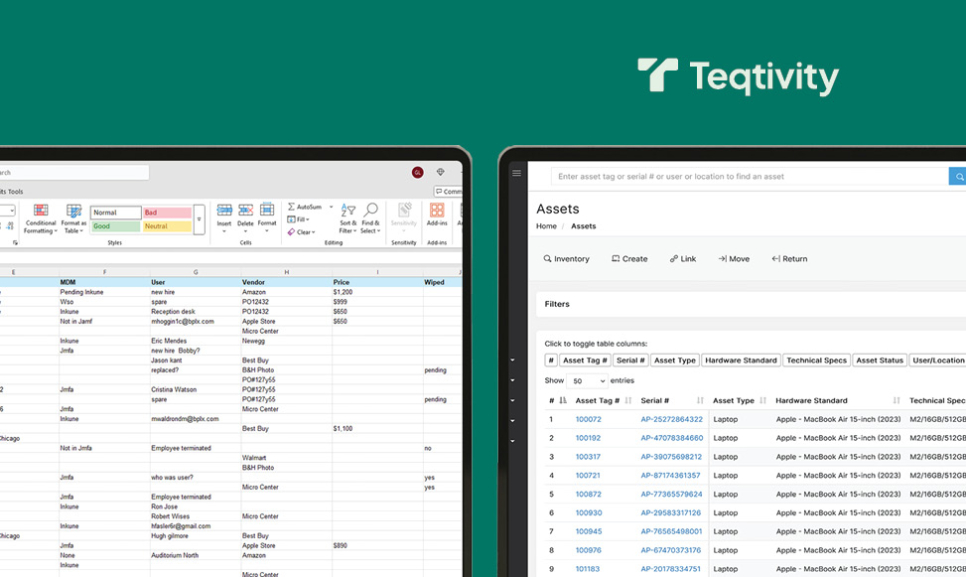
Spreadsheets might feel like a flexible starting point for IT asset management. They’re familiar, accessible, easy to set up, and seem like a no-cost solution. For many IT teams, that’s exactly how the journey begins: with a simple Excel or Google Sheet tracking a handful of devices.
But what starts as a quick fix quickly becomes a liability. As your organization grows, so does the complexity of managing assets. Spreadsheets become bloated, siloed, and error-prone. Suddenly, your team is spending hours manually updating rows, fixing broken formulas, or worse, making decisions based on outdated or incomplete data.
In this blog, we’ll explore why spreadsheets fall short as an ITAM solution, how those gaps cost you time and visibility, and why Teqtivity is the purpose-built alternative your team needs to manage IT assets accurately, efficiently, and at scale.
The Hidden Costs of Spreadsheet-Based ITAM
What may seem like a “free” solution often becomes one of the most expensive decisions over time.
Maintaining IT asset data in spreadsheets drains time and introduces avoidable risks. IT staff spend countless hours manually updating records, tracking asset assignments, and reconciling discrepancies, turning what should be routine management into a tedious chore. As organizations grow, version control becomes chaotic, especially when multiple teams create and edit their own copies. Errors are inevitable. One mistyped cell or overlooked row can throw off your entire inventory.
The problems go deeper. Spreadsheets provide no audit trail, no way to trace who changed what, or when. When compliance season rolls around, your team is left scrambling to piece together fragmented histories. And perhaps most critically, spreadsheets offer no real-time visibility. Without accurate, up-to-date information on asset location, assignment, or lifecycle status, decision-making becomes reactive and risky.
In short, spreadsheets introduce gaps in tracking and accountability. And in IT asset management, blind spots can cost you time, money, and compliance.
What Spreadsheets Can’t Do for IT Asset Management
Spreadsheets may feel like a flexible, low-cost way to track assets, but they simply weren’t built for modern IT environments. As organizations grow, these static tools become bottlenecks: manual, disconnected, and blind to change.
They can’t manage the full asset lifecycle.
From procurement and deployment to repair, reassignment, and retirement, spreadsheets lack the structure and triggers to support key asset transitions. There’s no way to automatically log updates or track where an asset is, who’s using it, or whether it’s approaching end-of-life.
They can’t integrate with your existing systems.
IT teams rely on a constellation of tools: help desks, MDM platforms, procurement software, and vendor portals. Spreadsheets live in isolation, which means you’re stuck copying data across systems, increasing workload and the risk of inconsistency.
They can’t deliver real-time insights.
Want to know what’s underutilized, missing, or nearing replacement? Spreadsheets require someone to manually pull and review outdated data. There are no live dashboards, alerts, or analytics to support fast, informed decisions.
They can’t support secure collaboration.
With multiple editors, data integrity breaks down. Version control, access rights, and audit trails are nonexistent, making it difficult to track changes or hold users accountable.
They can’t prepare you for audits or compliance.
When regulators or internal audits require proof of asset history, chain of custody, or certificates of data destruction, spreadsheets fall short. You’ll spend days piecing together fragmented records, hoping nothing slips through.
Spreadsheets were never meant to be ITAM systems. They’re inflexible, disconnected, and unfit for the pace and complexity of today’s IT operations.
Common Use Cases Where Spreadsheets Fail
Despite their initial appeal, spreadsheets quickly become problematic in everyday IT asset workflows. They lack the foundational capabilities that current IT environments demand, such as real-time tracking, lifecycle management, and system integrations. Here are some critical scenarios where spreadsheets consistently fall short:
- Employee Onboarding and Offboarding: When employees join or leave, IT needs to provision or reclaim devices quickly. With spreadsheets, tracking who has what and when it’s returned is unreliable and prone to delays.
- Remote and Hybrid Teams: When assets are distributed across locations, spreadsheets can’t deliver real-time visibility or integrate with MDM tools. This results in ghost assets, missed updates, and a lack of accountability.
- Device Loans and Shared Equipment: Spreadsheets don’t handle check-ins and check-outs well. Assets meant to be shared, like loaner laptops or monitors, are easily lost in a spreadsheet system.
- Departmental Budgeting and Forecasting: Spreadsheets lack automation for tracking depreciation, usage rates, or lifecycle stages, forcing teams to make decisions without reliable data. Strategic IT planning becomes a slow, error-prone process.
- Audit and Compliance Checks: Spreadsheets offer no activity logs, change tracking, or proof of asset history. When audit season hits, you’re left chasing fragmented, inconsistent data, making compliance reporting difficult and unreliable.
How Teqtivity Solves the Spreadsheet Problem: A More Efficient Option
Spreadsheets aren’t failing you because you’re using them wrong. They’re failing because they weren’t designed for IT asset management.
Teqtivity’s ITAM platform replaces outdated spreadsheets with a smarter, more scalable way to manage assets across their entire lifecycle. It gives your team real-time visibility, automated workflows, and centralized control over every asset from day one to end-of-life.
Here’s how Teqtivity helps IT teams move beyond spreadsheets and take control of their IT environment.
A Smarter Way to Manage IT Assets
Spreadsheets were never designed for IT asset management. Teqtivity is.
Instead of reacting to problems and chasing updates, IT teams using Teqtivity replace the guesswork of spreadsheets with accurate records and automatic updates across every stage of the asset lifecycle.
Track Assets from Start to Finish
Teqtivity logs every stage of the IT asset lifecycle, from purchase to deployment, reassignment, and retirement, so you always know:
- Who is assigned to each device
- Where it is located
- What condition it’s in
No more scattered files or missing information.
Works with Tools You Already Use
Teqtivity connects with systems like Jamf, Okta, Google Workspace, and Jira, so your systems work together instead of apart. Your systems stay in sync, and your asset data is always accurate. No duplicate entry required.
Makes Audits and Compliance Easier
With Teqtivity’s built-in reporting tools and compliance-ready features, you can:
- Track certificates and warranties
- Maintain detailed logs
- Control access by role (IT, finance, procurement)
This makes audit preparation faster and IT compliance easier, especially in regulated environments.
Let the System Handle Repetitive Tasks
Stop relying on memory, spreadsheets, or calendar reminders. With Teqtivity, you can set up IT asset management automation to flag:
- Assets nearing end-of-life
- Devices that haven’t been returned
- Warranties that are about to expire
This is more than tracking. It’s real control without the spreadsheet mess.
Everything Spreadsheets Can’t Do, Teqtivity Can
Here’s a side-by-side comparison to show what changes when you move from spreadsheets to Teqtivity:
| With Spreadsheets | With Teqtivity |
| Manually updated tabs | Automated lifecycle tracking |
| Inaccurate or outdated records | Real-time, centralized visibility |
| Stressful audits | Built-in reports and audit trails |
| Limited collaboration | Role-based access and multi-user control |
| Disconnected tools | Integrated with MDMs, vendors, and help desks |
Real-World Impact: What Happens When Teams Make the Switch
Organizations that move from spreadsheets to Teqtivity see measurable improvements. Time that was once lost to manual updates is reclaimed through automation and integrations. Audit readiness improves dramatically, thanks to always-on compliance tracking and detailed logs. Ghost assets become a thing of the past because every asset is accounted for in real time. And offboarding becomes smooth and secure with Teqtivity’s structured processes.
“Teqtivity makes asset management easy. It’s integrations with so many other platforms makes it versatile and extremely useful. Teqtivity is unique. Other ITAM systems are copy/paste.”
— IT Supply Chain Coordinator
If This Sounds Familiar, It’s Time to Rethink ITAM
If your IT asset management still runs on spreadsheets, it might be costing more than you think. Spreadsheets delay growth, reduce visibility, and introduce unnecessary risk. The longer you rely on manual tools, the more you miss in terms of efficiency, security, and control.
Teqtivity gives you the visibility, control, and confidence spreadsheets never could. It’s time to move from manual to managed.
Stop struggling with spreadsheets. Start managing IT assets the right way.
Key Takeaways
- Spreadsheets may work as a starting point, but they’re not scalable or sustainable for modern IT asset management. They’re a poor alternative to dedicated ITAM software.
- Without always up-to-date information and automation, spreadsheet-based tracking leads to time-consuming manual updates, version control issues, and costly human errors.
- Spreadsheets lack critical ITAM capabilities like asset lifecycle tracking, integrations with MDMs and help desks, and audit-ready reporting. They create major blind spots for growing organizations.
- Switching to Teqtivity, a purpose-built IT asset management platform, gives teams centralized control, automated workflows, and the visibility needed to manage assets accurately and at scale.