7 Common Gaps in Enterprise Asset Management Capabilities and How to Fix Them

Even with the best tools by your side, enterprise asset management doesn’t always run smoothly. Many organizations think they have everything under control — until assets go missing, maintenance is delayed, or compliance issues arise. That’s because there are often hidden gaps in their enterprise asset management capabilities.
Unfortunately, these gaps can quietly contribute to compromised asset performance, budgeting issues, and inefficient business operations. The upside? These problems are fixable. So, let’s look at seven common gaps that often get overlooked — and show you practical ways to close them.
7 Gaps in Enterprise Asset Management Capabilities & Their Solutions
Many organizations using an EAM solution assume everything is running like clockwork. Still, many issues can pile up under the safe, creating gaps in IT asset management processes and visibility. That is why enterprises face issues like operational delays, unexpected breakdowns, and budget drains.
How to fix them? The first step is knowing where to look. Below are the seven common gaps in enterprise asset management capabilities that many organizations face, and some simple solutions to start closing them.
| Gap | Risks | Solution |
| Insufficient Asset Visibility | Unaccounted devices, security issues | Real-time, automated lifecycle tracking |
| Siloed Integration | Low data quality, manual errors | Seamless HR/ITSM integration, automated onboarding/offboarding |
| Underuse of System Features | Lost automation, poor ROI | Systematic enablement and feature adoption |
| Security Gaps | Breaches, non-compliance | Automated compliance, zero-trust, ongoing reviews |
| Hybrid/Mobile Blind Spots | Increased theft/loss, wasted assets | Mobile tracking, remote discovery |
| Lifecycle Management Shortfalls | Budget leakage, compliance failures | End-to-end workflow automation |
| Reporting/Analytics Deficiency | Missed trends, audit/finance risk | Dashboards, actionable data exports |
The table above highlights the gaps and their consequences. It also briefly discusses the solutions to avoid these problems. Now, let’s look at these gaps and their solutions in detail to get a better understanding:
- Insufficient Asset Visibility
Many enterprises struggle with limited real-time insight into their physical assets, especially with remote/hybrid workforces. So, incomplete asset records often lead to devices going missing, creating unaccountability and security vulnerabilities within the enterprise.
What’s worse is that the problem just doesn’t end here. Outdated, traditional inventory management also leads to unnecessary purchases and operational bottlenecks, affecting the overall organizational efficiency and productivity.
The only way to solve this problem is by upgrading your asset tracking method. For example, modern EAM tools use RFID tags and barcodes to label and track assets with real-time dashboards, providing end-to-end transparency throughout an asset’s lifecycle.
Therefore, the key is to use advanced inventory management tools and say goodbye to manual and outdated processes. This approach helps optimize asset utilization, maximize asset control, and ensure audit-readiness.
- Limited Integration & Siloed Processes
Older inventory management tools don’t connect to existing enterprise systems, creating data silos. Many organizations implement manual workarounds to fix this problem. Unfortunately, this approach can lead to human errors and demand hours of time from your IT team. Furthermore, data fragmentation caused by the lack of integrations can significantly impact data consistency and quality, affecting the organization’s decision-making.
Let’s say a healthcare organization uses an HR platform for staff onboarding and offboarding, a help desk system to handle IT support tickets, and an MDM to secure all assets used by doctors and technicians. The problem is, their EAM system doesn’t allow integration with these solutions.
So, what happens? The EAM system causes delays in assigning equipment to new hires, fails to deactivate assets for offboarded staff, and burdens the help desk with avoidable support requests. The results include security risks, asset misplacements, compliance issues, and hours of wasted time.
You can always switch to a good enterprise asset management system that integrates with existing platforms. This ensures effective and unified IT asset management, and faster onboarding/offboarding. The best part is that there’s no wasted time between all these operations.
- Underuse of System Features
Many organizations might not use all the features of their EAM software. The main reasons behind this are the lack of awareness and training among IT teams and employees to fully utilize an enterprise asset management tool. Therefore, many enterprises don’t even use the advanced features of a modern EAM solution, such as automated workflows, advanced analytics, and asset lifecycle management.
Instead, these organizations still end up relying on basic inventory management and tracking. The underuse of EAM systems leads businesses to miss out on significant efficiency gains. For instance, tasks that could be automated stay manual. Insights about management capabilities that could help in smarter decision-making remain unusable.
The best way to fix this problem is to invest in a user-friendly EAM tool, such as Teqtivity. It provides better onboarding and training, so IT teams and all stakeholders of an organization can fully understand the system usage. This ensures that businesses utilize every single tool to improve asset utilization and reduce operational costs.
- Security Gaps
Security in an organization is not just limited to firewalls and passwords; it’s also about knowing your physical assets’ locations, condition, and assignments. Unfortunately, many organizations still face issues like lost and untracked devices. These can be potential windows for serious risks, especially if those assets hold sensitive data about staff or the organization’s operations.
For example, if an employee leaves and their assigned device is not properly offboarded, it creates an endpoint for cyber threats to exploit. Moreover, this device might not quietly disappear from the inventory, creating gaps in audits.
To create a zero-trust security system, implement a modern EAM solution, such as Teqtivity. It allows your organization to properly offboard devices during staff transitions. Also, it logs all disposals and enables enterprises to create audit-ready documentation.
- Hybrid Work Blind Spots
A remote or hybrid work model can create blind spots in enterprises. Furthermore, a survey by EY found that 72% of 501 businesses now had a hybrid remote/onsite approach. This number has been growing consistently since the COVID-19 pandemic.
But the problem with these working models is that assets are distributed across multiple home offices and workspaces. This increases the risk of device theft, loss, and misplacement, reducing the asset utilization rate and increasing unnecessary costs.
The quick solution to this problem is to use an EAM solution that automates asset discovery and centralizes data. This allows organizations to see their assets, regardless of where they are. Furthermore, consider integrating your EAM system with another platform, such as MDM, to track laptops and mobile assets scattered across multiple locations.
- Hardware Lifecycle Management Shortfalls
Many organizations don’t track the complete asset lifecycle. They might start asset management after the deployment of a device and exclude maintenance, procurement, usage, or disposal. Skipping even one of these phases can have consequences.
For instance, you miss the maintenance phase of your asset lifecycle. Therefore, you might be unable to set preventive maintenance schedules, leading to unplanned breakdowns and increased emergency repair costs.
The solution is simple. Choose an EAM solution that either provides the complete asset lifecycle management or lets you customize tracking stages. This approach allows you to control the total cost of ownership for every single asset.
- Data Reporting & Analytics Deficiency
Around 26% of businesses still use spreadsheets for inventory management, while 41% rely on manual inventory processes. The results? These organizations spend hours finding the required data. Integrations are impossible with these outdated solutions, and data silos become a routine part of enterprises.
Worst of all, these outdated and manual processes don’t provide enterprises with any actionable analytics or reports. Hence, these businesses fail to make any data-driven decisions about procurement, maintenance, and retirement.
To overcome this, consider using an EAM system, such as Teqtivity. It tracks all your important data through detailed dashboards and reporting. This way, you can track all the KPIs to ensure smart inventory management and make informed decisions to improve your EAM strategy.
5 Ways to Fix the Gaps in Enterprise Asset Management Capabilities
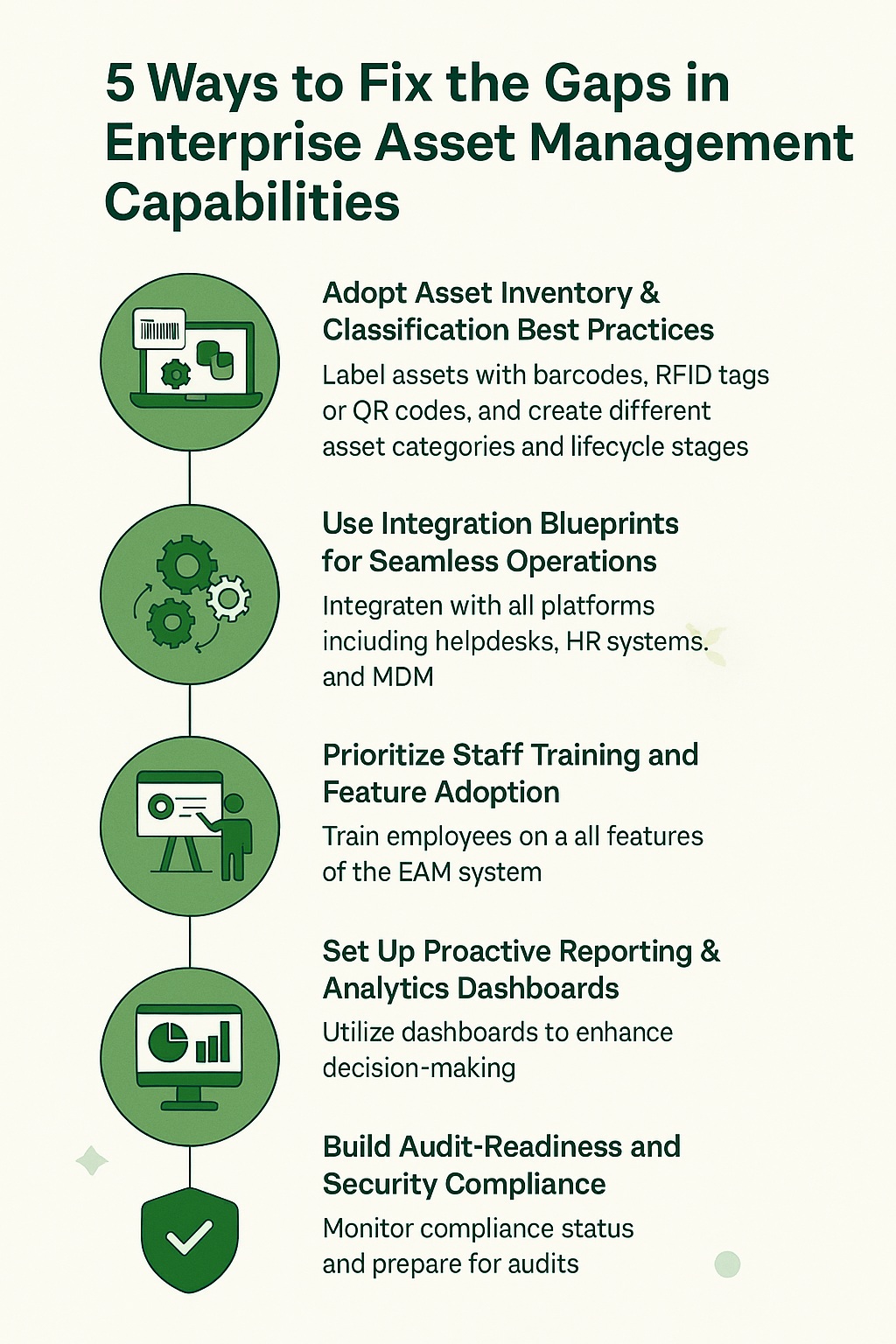
Some quick solutions can help you close the gaps temporarily. However, let’s look at some ways to permanently fix these enterprise asset management capabilities gaps:
- Adopt Asset Inventory & Classification Best Practices
A well-maintained asset inventory is one of the best EAM practices you can adopt. But how to maintain your inventory? Start by labeling every asset with easy-to-track solutions, like barcodes, RFID tags, or QR codes. You can monitor every laptop, server, mobile device, or peripheral across multiple locations to ensure effective inventory management.
The next step is to create different asset categories and lifecycle stages. This allows organizations to optimize asset deployment, plan maintenance, and track utilization across the full journey of your device. Furthermore, smart maintenance extends asset lifecycles and reduces operational inefficiency.
- Use Integration Blueprints for Seamless Operations
A modern enterprise requires smart EAM solutions that collaborate well with existing platforms, like helpdesks, HR systems, MDM, Vendor & Supplier Management, and APIs. That is why effective EAM systems, such as Teqtivity, integrate seamlessly with Jira, Okta, Slam, Workday, etc.
The immediate result of these integrations is the elimination of data silos, speeds up the response to service requests and synchronizes data across all platforms. This way every department has access to accurate data. Moreover, integration means less manual entry, more reliable asset management, and proactive compliance measures.
- Prioritize Staff Training and Feature Adoption
Many organizations still use only the basic features of their EAM software. That is where you can outmatch your competitors. The first step is to train your employees, so they can fully adopt every feature of the EAM system. This allows your IT teams to maximize asset performance and significantly reduce operational costs.
- Set Up Proactive Reporting & Analytics Dashboards
Real-time visibility is one of the most important enterprise asset management capabilities. Therefore, it is important to set up dashboards to track asset conditions, and end-of-life plans. This utilizes your proactive reporting to make smarter decisions and enable cost control.
In addition, an EAM tool like Teqtivity provides detailed dashboards, so every stakeholder and department head can stay updated with real-time data. As a result, you can make smart, data-driven decisions about compliance, procurement, maintenance, etc.
- Build Audit-Readiness and Security Compliance
Non-compliance pitfalls can be quite risky. They can result in financial penalties, operational suspension, legal disputes, and reputational harm. Therefore, security and compliance must be one of the top priorities for an organization. Luckily, you can easily maintain your compliance status with an EAM solution like Teqtivity.
Modern EAM systems allow you to monitor the compliance status of every new and old asset, so you can ensure that every device follows regulatory standards. In addition, tools like Teqtivity provide detailed logs, which help in internal and external audits. They work as audit-ready documents, ensuring your organization meets compliance needs.
How Teqtivity Solves These Gaps in Enterprise Asset Management Capabilities
Teqtivity is one of the most effective EAM solutions for on-site, remote, and hybrid enterprises. It provides these features to close the common gaps in enterprise asset management capabilities:
- Teqtivity provides complete asset lifecycle management, allowing you to track the full journey of a device from procurement to disposal. It also enables you to take proactive steps for maintenance and secure retirement.
- It offers visual dashboards that are easy to understand for both technical and non-technical stakeholders within the enterprise. This also ensures quick adoption and a smoother learning curve within the organization.
- Teqtivity seamlessly integrates with your existing systems, including MDM, ITAD, Vendor & Supplier Management, People Management, APIs, and Webhooks. This approach provides unified and consistent data across all platforms.
Simply put, Teqtivity covers all the gaps that are present in a traditional enterprise asset management approach. It optimizes your operations, increases cost savings, and maintains compliance across multiple locations, allowing you to have better control over everything.
Have you also noticed these gaps in your enterprise asset management capabilities? Then a timely switch to Teqtivity can solve your problems. This comprehensive asset and inventory management tool provides centralization to track assets across multiple departments and locations. The best part? Automation takes care of everything, so you can focus on more important work. So, give Teqtivity a try now or book a free demo and see how it works!
Key Takeaways
Before leaving, read the key takeaways from the article:
- Every organization should adopt a modern EAM solution for effective asset tracking. It allows you to gain real-time visibility and reduces lost devices. It is a much better approach than spreadsheets and manual workarounds.
- The best way to fully utilize your EAM software is to train your staff. Also, automate where possible, such as work order management, asset allocation, compliance monitoring, and cost control.
- A proactive approach gives you many more benefits and reduces sudden breakdowns that lead to operational disruptions and costly repairs.
- Make sure to track all the key metrics, insights, and reports from your EAM software. This way, you can maximize the utilization of enterprise asset management capabilities and make data-driven decisions.
- Prioritize a tool like Teqtivity that supports audit-readiness with detailed logs of every asset, ensuring your assets stay compliant with regulatory standards.